

Anti-Drone Market Size Set to Hit US$ 20.39 Billion by 2035 as Governments Race to Counter Drone Threats
Anti-Drone Market
Detection systems, portable platforms, and surging Asia-Pacific demand are reshaping how airports, militaries, and cities counter rogue drones.
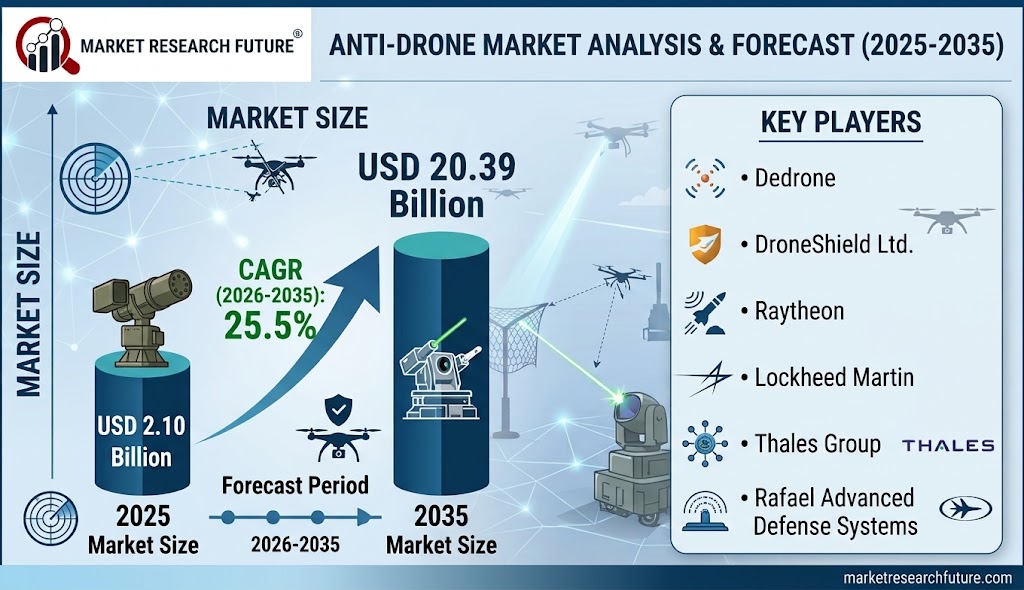
NEW YORK, NY, UNITED STATES, September 2, 2026 /EINPresswire.com/ -- The global anti-drone market is entering a decade of rapid expansion as unauthorized drone activity around airports, power plants, prisons, stadiums, and defense installations forces governments and private operators to rethink airspace protection. According to recently compiled industry analysis, the anti-drone market was valued at roughly US$ 2.10 billion in 2025 and is on track to climb to approximately US$ 20.39 billion by 2035, expanding at a compound annual growth rate of nearly 25.5% between 2026 and 2035. That trajectory would mark one of the steepest growth curves in the broader aerospace and defense technology landscape, reflecting how quickly counter-drone capability has moved from a specialized military requirement to a mainstream security investment.The shift is being driven by a convergence of forces: a surge in reported drone incursions at sensitive sites, new regulatory mandates requiring detection infrastructure at airports and borders, and escalating geopolitical tensions that have turned small commercial drones into a recognized battlefield and homeland-security threat. Industry watchers note that policy actions in North America and Europe — including expanded airport perimeter-detection requirements and coordinated counter-UAS action plans — have effectively converted what was once a niche defense procurement category into a broad-based commercial and government security market.
Market Overview: From Niche Defense Tool to Mainstream Security Category
For much of the past decade, counter-drone technology was largely confined to military and high-security government applications. That has changed markedly since 2020, as low-cost commercial drones have proliferated and incidents of unauthorized flights near airports, correctional facilities, energy infrastructure, and large public gatherings have multiplied. High-profile airspace disruptions at major airports have become reference points that security planners cite when building the business case for layered detection and mitigation systems.
Request for Free Sample of Report: https://www.marketresearchfuture.com/sample_request/6460
Today's anti-drone platforms increasingly combine multiple sensing modalities — radar, radio-frequency analysis, electro-optical and infrared imaging, and acoustic detection — into unified, software-driven consoles that use artificial intelligence to classify threats and reduce false alarms. This technological maturation is a key reason procurement cycles that once stretched beyond a year are now compressing to a matter of months for some commercial buyers, particularly those adopting subscription-style, detection-as-a-service models rather than large upfront capital purchases.
Key Growth Drivers Shaping the Anti-Drone Market:
Several structural drivers are underpinning the anti-drone market's growth trajectory:
Airspace incursions at critical infrastructure. Airports, prisons, energy facilities, and government compounds have all reported rising numbers of unauthorized drone sightings in recent years, pushing perimeter security budgets toward layered detection architectures rather than single-sensor solutions.
Regulatory mandates for airport and border detection. Policymakers in the United States and Europe have moved to formalize detection requirements and clarify which agencies may deploy active countermeasures, giving procurement teams a clearer legal pathway to move from pilot programs to standardized acquisition.
Geopolitical conflict and defense procurement acceleration. The use of low-cost commercial and militarized drones in recent conflicts has demonstrated their battlefield lethality, prompting defense ministries across NATO member states and beyond to significantly increase counter-small-unmanned-aircraft-systems budgets.
AI-powered sensor fusion. Machine-learning classifiers that merge radar tracking, RF signature analysis, and optical imagery have meaningfully cut false-positive rates, making automated alerting and response viable for security operations centers that previously relied on manual verification.
Commercial drone fleet expansion. As the population of civilian and commercial drones grows worldwide, the potential threat surface for accidental or malicious incursions expands correspondingly, sustaining long-term demand for detection infrastructure.
Remote ID enforcement and compliance cycles. New drone-identification broadcast requirements are creating a technical and legal foundation that counter-drone vendors can build upon to distinguish cooperative from non-cooperative aircraft in real time.
Segmentation Analysis: Detection Still Leads, But Countermeasures Are Catching Up
The anti-drone market is typically segmented by technology, platform type, end-use vertical, and operating range, and each cut of the data tells a slightly different growth story.
By Technology: Detection systems — encompassing radar, radio-frequency sensors, electro-optical/infrared cameras, and acoustic arrays — account for the largest share of current market revenue, representing an estimated 57 to 58 percent of spending in 2025. This reflects a common procurement pattern in which organizations first invest in situational awareness before layering in active defeat capability. Neutralization and countermeasure systems, which include RF jammers, GPS spoofers, net-capture interceptors, and directed-energy effectors, are forecast to be the faster-growing technology segment, expanding at roughly a 25 percent compound annual rate as legal frameworks in more jurisdictions extend authorization for active defeat measures beyond federal military agencies alone.
By Platform Type: Fixed installations — the permanent radar and sensor arrays deployed around airports, military bases, and correctional facilities — currently hold the largest platform-type share, at roughly 43 percent of 2025 revenue, owing to the persistent, round-the-clock coverage these sites require. Portable and man-portable systems, however, are growing faster, at an estimated 26 percent CAGR, as special-operations units, executive-protection teams, and temporary event organizers seek rapid-deployment solutions that can be operational within hours.
By End-Use Vertical: Commercial facilities — a category spanning stadiums, data centers, logistics hubs, and energy plants — represent the single largest end-use vertical, accounting for close to 47 percent of 2025 spending. Homeland security and law-enforcement deployments are expanding at a notably faster pace, projected near a 28 percent CAGR, as remote-identification enforcement obligations give agencies both the legal mandate and the technical means to police non-compliant drone activity.
By Operating Range: Medium-range systems, generally defined as covering roughly one to five kilometers, form the largest range-based segment at an estimated 44 percent share, aligning closely with the buffer zones typically established around airports and military installations. Short-range systems, covering roughly one kilometer or less, are the fastest-growing range category at an estimated 24 percent CAGR, driven by demand for lightweight, backpack-portable units used in convoy protection and urban law-enforcement operations. Long-range systems, built for national border and strategic-asset surveillance, remain the smallest segment by absolute value but continue to see steady investment tied to border-security modernization programs.
Regional Insights: North America Leads, Asia-Pacific Accelerates
North America currently commands the largest regional share of the global anti-drone market, at an estimated 43 to 44 percent of 2025 revenue, underpinned by the combined procurement power of national defense budgets, homeland security agencies, and commercial airport authorities. The United States alone is believed to account for the large majority of the region's spending, reflecting sustained federal investment in counter-small-unmanned-aircraft-systems programs alongside civil-aviation mandates tied to airport perimeter detection.
Europe holds the second-largest regional position, with an estimated market value in the range of USD 0.55 to 0.60 billion for 2025, propelled by NATO interoperability standards and heightened urgency stemming from conflict in Eastern Europe. Several major European economies have introduced critical-infrastructure protection laws that effectively mandate drone-detection capability at energy, water, and transportation facilities, creating a steady compliance-driven demand base across the region.
Asia-Pacific stands out as the fastest-growing region worldwide, with growth estimated near a 29 percent compound annual rate through 2035. Government-led border-security programs, airport-modernization initiatives, and expanding indigenous defense-technology ecosystems in markets such as India, Japan, and South Korea are fueling this acceleration. South America, while still a comparatively small contributor to global revenue, is also growing quickly — at an estimated 23 to 24 percent CAGR — as countries in the region roll out drone-detection mandates for correctional facilities and other critical sites. The Middle East and Africa region, valued at an estimated USD 0.10 to 0.15 billion in 2025, continues to see investment tied to energy-asset protection and broader geopolitical security concerns.
Competitive Landscape: Defense Primes and Specialist Innovators Compete for Share
The anti-drone market remains moderately fragmented, with the leading vendors together holding an estimated 28 to 38 percent combined revenue share. The competitive field blends established aerospace and defense primes — which integrate counter-drone modules into broader force-protection portfolios — with specialist pure-play companies that have built strong brand recognition through fast deployment cycles and early government pilot programs.
Key companies shaping the competitive landscape include Dedrone, a pioneer in commercial counter-UAS technology now operating under Axon's ownership following a 2024 acquisition; DroneShield Ltd., recognized for its portable detection and jamming product lines and a strong government contracting base; Raytheon (RTX), which brings defense-prime scale and integrates counter-drone effectors across its broader air-defense portfolio; Lockheed Martin, active in directed-energy and autonomous intercept platforms; Thales Group, a European market anchor with airport- and event-security specialization; and Rafael Advanced Defense Systems, known for combat-proven, multi-domain counter-drone systems.
Additional notable players include Rohde & Schwarz, which brings deep radio-frequency detection and jamming expertise with a strong NATO and European footprint; D-Fend Solutions, focused on non-kinetic, cyber-takeover approaches to neutralizing rogue drones with minimal collateral risk; Hensoldt, recognized for passive-radar innovation within German and broader European defense integration; and SRC Inc., whose radar-centric systems have seen fielded deployment with U.S. Army programs. Merger and acquisition activity has intensified across the sector since 2023, as larger defense organizations acquire specialized sensor and software start-ups to close capability gaps and accelerate time-to-market for integrated detect-and-defeat platforms.
Opportunities on the Horizon:
Beyond the core growth drivers, several emerging opportunities are expected to shape the next phase of anti-drone market expansion.
Drone-defense-as-a-service for temporary venues. Stadiums, festivals, and large political or cultural events increasingly require short-term, modular counter-drone coverage rather than permanent installations, opening a services-oriented segment that industry estimates suggest could approach the low billions in value by the early 2030s.
AI-driven autonomous detect-and-defeat platforms. Systems capable of moving from detection through classification to an authorized response without human-in-the-loop delay represent a significant performance frontier, particularly as swarm-drone tactics demand engagement timelines measured in seconds rather than minutes.
Emerging-market airport and border modernization. Multi-year national programs to outfit dozens of airports and border installations with counter-drone systems are underway in South Asia and are being mirrored by similar initiatives across Southeast Asia and the Gulf Cooperation Council states, positioning these regions for accelerated adoption.
Threat-intelligence monetization. Detection platforms generate substantial data on flight paths, RF signatures, and incursion patterns. Vendors that package this information into subscription threat-intelligence feeds for aviation authorities, insurers, and law-enforcement fusion centers stand to build high-margin, recurring-revenue business lines.
Smart-city security integration. As municipal surveillance ecosystems converge video analytics, acoustic detection, and airspace monitoring onto unified command dashboards, counter-drone modules designed to plug into existing smart-city infrastructure — rather than requiring standalone command centers — are likely to see faster municipal adoption.
Restraints Tempering Near-Term Growth:
Despite the market's strong outlook, several headwinds continue to shape adoption timelines. High upfront capital costs for fully integrated detect-track-identify-defeat systems remain a barrier for many mid-tier airports and commercial venues, even as subscription and as-a-service delivery models begin to lower entry costs. Legal restrictions in several Western jurisdictions continue to limit active countermeasure deployment — such as RF jamming or kinetic interception — to a narrow set of authorized federal agencies, constraining the addressable buyer base in certain markets. Elevated false-alarm rates in dense urban environments, fragmented regulatory frameworks across countries, and interoperability gaps between vendor-specific systems round out the list of factors that vendors and buyers alike must navigate as the market matures.
Outlook: A Market Entering Its Growth Inflection Point
"The anti-drone sector has moved past the early-adopter phase," said a senior analyst covering the aerospace and defense security space. "What we're seeing now is a genuine inflection point, where regulatory clarity, proven technology, and real-world incidents are combining to push counter-drone investment into mainstream security budgets — not just defense ministries, but airport authorities, utilities, correctional systems, and event operators as well."
Looking further ahead, industry observers expect autonomous decision architectures, directed-energy defeat systems, and harmonized international standards to define the next wave of innovation. Directed-energy systems such as high-power lasers and microwave effectors are transitioning from laboratory prototypes toward field-deployable units, offering near-zero marginal cost per engagement and altering the long-term economics of sustained counter-drone operations. Meanwhile, efforts by international aviation bodies to harmonize detection standards are expected to reduce vendor lock-in and lower cross-border procurement friction, potentially accelerating adoption in regions where regulatory uncertainty has so far constrained investment.
Taken together, these dynamics point to a market that is not only growing quickly in dollar terms but also maturing structurally — moving from fragmented, single-purpose deployments toward integrated, AI-enabled security ecosystems that span military, government, and commercial buyers alike. With the market on pace to grow roughly tenfold over the coming decade, stakeholders across defense, aviation, critical infrastructure, and public event security are likely to keep counter-drone investment high on their strategic agendas through the mid-2030s.
Browse More Reports:
Drone Power Source Market
https://www.marketresearchfuture.com/reports/drone-power-source-market-26947
Aerial Target Drone Market
https://www.marketresearchfuture.com/reports/aerial-target-drone-market-33810
Drone Navigation System Market
https://www.marketresearchfuture.com/reports/drone-navigation-system-market-40340
Market Research Future
Market Research Future
+ +1 855-661-4441
sales@marketresearchfuture.com
Legal Disclaimer:
EIN Presswire provides this news content "as is" without warranty of any kind. We do not accept any responsibility or liability for the accuracy, content, images, videos, licenses, completeness, legality, or reliability of the information contained in this article. If you have any complaints or copyright issues related to this article, kindly contact the author above.
